What Is Zarafa? The Email Server Behind Kopano, and Where It Went
Zarafa was an open source email and calendar server that stood in for Microsoft Exchange. Kopano carries its code forward. Jump to your question below, or work through it in order.

Zarafa was an open source email and calendar server that stood in for Microsoft Exchange. Kopano carries its code forward. Jump to your question below, or work through it in order.
Zarafa was a Linux email and calendar server that Outlook users could connect to like Exchange. It started in Delft in the Netherlands. Zarafa BV built it. The server code was open source under the AGPL.
Kopano replaced the Zarafa name in 2016. Its core is a fork of ZCP 7.2.3. Wikipedia lists ZCP 7.2.5 from 7 January 2017 as the last release. The vendor says its Groupware line has reached end of life.
Zarafa kept mail in a MySQL database and could keep attachments as files on disk. Section 10 shows how to move mail out with standard tools.
Picture a Linux server in a back room. Its login page says WebApp and its folders say zarafa. Nobody left a note. You search for Zarafa.
Zarafa was open source groupware. That means one server for mail, calendars, contacts and tasks. Wikipedia says it was meant as an alternative to Microsoft Exchange Server.
Zarafa started in Delft in the Netherlands. The company behind it, Zarafa BV, was earlier named Connectux. Outlook users could keep the mail program they already knew.
The server ran on Linux. It kept mail in a MySQL database and spoke MAPI to Outlook inside SOAP messages. Staff without Outlook used a browser client that looked like Outlook Web Access.
The name has since changed to Kopano. That is why one family of software has two names. Section 2 dates the change.
Old servers outlive the people who built them. A box in a closet keeps answering mail for years. Then an audit finds it.
Others hold exports or backups from a server that is long gone. They need to know what the files are. Section 7 and section 11 answer that.
Zarafa is the original name and Kopano is the successor. The new core began as a fork of that code. Old and new servers share most of their design.
Old installs and old guides use the Zarafa brand. ZCP is the name of its server package. You meet that short name in package lists and in the Kopano migration manual.
Newer installs use the Kopano brand. Folder names on the server show which one you hold. Section 7 lists them.
Came here from a different server? Exchange Server page covers the Microsoft product that Zarafa set out to replace. Zimbra mail covers another Linux groupware server. Lotus Notes covers an unrelated groupware server. The email applications hub lists every mail program we cover.
The name changed from Zarafa to Kopano in 2016. ZCP 7.2.5 in January 2017 is the last release on record. Version 8.7.25 of Kopano Core in February 2022 is the latest Wikipedia lists.
The name changed in 2016. Wikipedia gives no month for it. Two records pin the change down.
Debian packagers imported Kopano 8.0.1 on 22 August 2016. A Collax developer wrote on 26 October 2016 that the product had been renamed. By then the change was done.
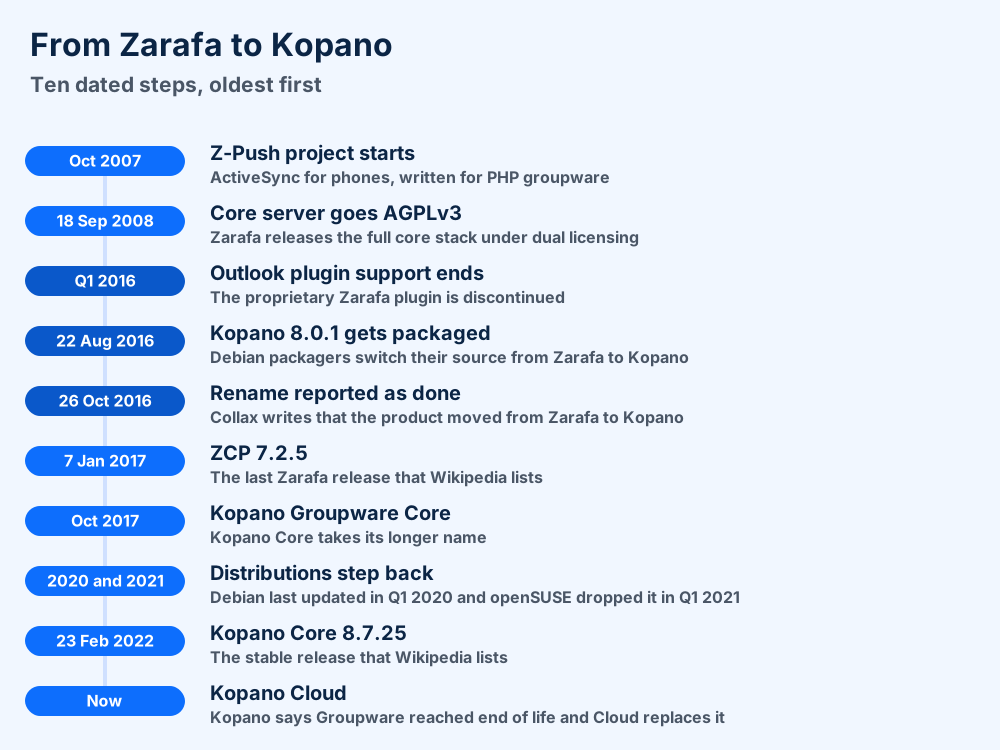
Start with the early dates. The Z-Push project began in October 2007. It brought phone sync to PHP mail servers.
The full core server stack went out under AGPLv3 on 18 September 2008. That was part of a dual licensing plan. Open code and paid editions shared one product.
The Outlook plugin date hurt most. Support for it was discontinued after Q1 2016. Offices built around Outlook had to find a new route.
The fork came from the release that was current at the time. The migration manual calls it a fork of ZCP 7.2.3. Collax adds that the AGPL stayed.
Collax also saw new parts. The fork holds more than ZCP did, including Kopano Backup and Kopano Search. The author wrote that the design had been completely revised.
After the fork the old name faded. Wikipedia lists ZCP 7.2.5 from 7 January 2017 as the last release under it. Since October 2017 the fork has also gone by Kopano Groupware Core.
Distributions then stepped back. Debian saw its last package update in Q1 2020. openSUSE removed the package in Q1 2021 after build failures with newer toolchains.
Wikipedia lists version 8.7.25 from 23 February 2022 as the latest stable release. The vendor site now sells Kopano Cloud. It says the Groupware line reached end of life.
Wikipedia and the vendor site give different years for that end. This page names none. Check the vendor site for the exact date.
Zarafa puts one server between every client and the data. Clients ask the server for mail. The server asks MySQL. A directory tells it who the users are.
Zarafa follows a simple plan. Clients never touch the data. They talk to a server and the server talks to a database.
The server answers MAPI calls. Programs that connect to it directly send MAPI inside SOAP. SOAP is XML sent over HTTP 1.1 on port 80 or on port 443 for HTTPS.
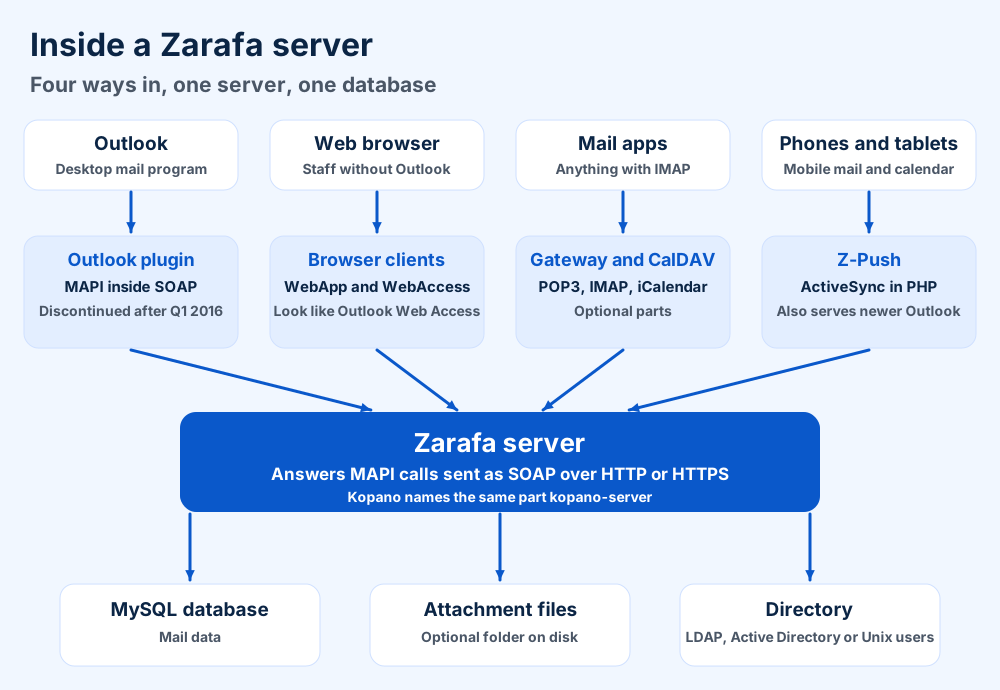
The manual says SOAP can pass through ordinary proxies because it rides on plain web ports.
The browser client and the phone sync layer are PHP programs. The manual says WebApp and Z-Push rely on the php-mapi module. That module lets PHP code speak MAPI to the server.
Ordinary mail apps use an optional gateway. Wikipedia says Zarafa also served POP3, IMAP and iCalendar or CalDAV clients. Any mail app with IMAP can read a mailbox.
User accounts come from a directory. Wikipedia names LDAP, Active Directory, Unix accounts and MySQL as sources. Connections can use TLS or SSL, directly or through an HTTPS proxy.
Say you click a message in WebApp. Your browser asks a PHP page for it. The page uses php-mapi to ask the server over SOAP.
The server reads MySQL for the message. If attachments sit on disk it reads them from the attachment folder. Then it hands the result back up the chain.
Outlook with the old plugin used MAPI to reach the server. A phone goes through Z-Push instead. Z-Push speaks ActiveSync to the phone and php-mapi to the server.
The manual says Outlook now connects through Z-Push with ActiveSync. Section 6 covers that change.
MAPI is a Windows interface that lets software work with Exchange. Outlook speaks it and the server answers it. SOAP is the envelope that carries those calls over the web.
ActiveSync is a closed Microsoft standard for syncing devices. LDAP is a protocol for looking up users in a central directory. The server leans on both.
ZCP is the server. WebApp and WebAccess are the browser clients. Z-Push syncs phones. The Outlook plugin was a separate proprietary add on.
The product had more parts than its name suggests. Four short names cause most of the confusion. This table sorts them out.
| Part | What it did | Where it stands |
|---|---|---|
| ZCP | The Zarafa Collaboration Platform, the server package. | Forked as Kopano Core from ZCP 7.2.3. |
| WebAccess | The older Ajax browser client. | WebApp is the newer client. |
| WebApp | The HTML5 browser client with a PHP backend. | Still a Kopano part. Version 5.3.2 dates from 2023. |
| Outlook plugin | A proprietary add on that linked Outlook by MAPI. | Support ended after Q1 2016. |
| Z-Push | An ActiveSync server for phones, started in October 2007. | Now a community project under AGPLv3. |
| Gateway | POP3, IMAP and CalDAV for standard apps. | Optional part. |
ZCP stands for Zarafa Collaboration Platform. A Fedora package of ZCP 7.1.12 called it a Microsoft Exchange replacement. The package label read open source edition.
That label matters because the edition set what you got. Wikipedia says the open source edition did not support MAPI based Outlook users.
WebAccess and WebApp are both mail clients that work in a browser. WebAccess used Ajax. WebApp is the newer client. It uses HTML5 and keeps the look of Outlook Web Access.
Staff who knew Outlook Web Access felt at home in it. SquirrelMail is another browser mail client with a page of its own.
Z-Push has outlived the brand. Zarafa Deutschland GmbH wrote it and the Z-Push site lists it as free software under AGPLv3. Wikipedia adds that Kopano said in October 2022 it would stop supporting the project. A community maintainer took over.
Kopano's administrator manual splits the server into small programs. Every program does one job. Old installs follow the same plan because the fork grew from that code.
| Program | Package name | Job |
|---|---|---|
| Server | kopano-server | Takes client calls over SOAP and stores data in SQL. |
| Delivery agent | kopano-dagent | Hands incoming mail to a user. |
| Spooler | kopano-spooler | Sends queued outgoing mail on. |
| Gateway | kopano-gateway | Optional POP3 and IMAP access. |
| CalDAV | kopano-caldav | Optional iCal and CalDAV support. |
| Monitor | kopano-monitor | Watches user stores for quota overruns. |
| Backup | kopano-backup | Makes brick level backups with partial restore. |
| Search | kopano-search | Optional full text index of mail and attachments. |
The delivery agent and spooler matter during a move. Mail flows through them to reach the server or leave it. Ask the admin whether to pause delivery during the copy.
The manual lists three more parts. A presence daemon feeds WebApp with user status. A command line tool called kopano-admin manages users and groups. The manual also says WebApp ties in chat and video calls.
Keep the server and the database. Keep the gateway if you plan to use IMAP. WebApp is optional because it only serves browsers.
Tell staff before the copy starts. New mail that lands mid copy will be missing from the first pass. Plan a second pass for it.
Search deserves a second look. It is optional and it builds a full text index of mail and attachments. Indexes take time to build. Plan for that wait after any restore.
The core server was free software under the AGPL. Advanced features and full Outlook support sat in commercially supported editions.
Zarafa sat between free and paid. The server code was open. The extras that big offices wanted were sold.
| Item | License or edition | Note |
|---|---|---|
| Core server stack | AGPLv3 from 18 September 2008 | Dual licensing plan. |
| WebApp and WebAccess | AGPL | Same license as the server side. |
| Outlook plugin | Proprietary | Support ended after Q1 2016. |
| Commercial editions | Small Business, Professional and Enterprise | Advanced features lived here. |
| Outlook users | Community edition allowed three | The open source edition did not support MAPI Outlook users. |
| Z-Push | AGPLv3 | Developers add backends for their own groupware. |
| Kopano Core | AGPL | Fork of ZCP. |
| Kopano Cloud | Not open source | Differs from its predecessors. |
Dual licensing means one code base sold under two sets of terms. The open terms cost nothing. The paid terms add support and extras.
The Outlook limit is a detail worth knowing. Wikipedia says the community edition supported three Outlook users.
"Kopano Core is a fork of ZCP 7.2.3."Kopano Migration Manual, drop in migration from Zarafa
That fork matters for licensing. The AGPL carried over to the fork, as the Collax report from October 2016 confirms. Source code from an old ZCP release is still close kin to the new core.
The cloud product breaks the pattern. The vendor site says it ships as containers. Wikipedia says it is not available under an open source license.
Check the terms before you plan a move to Kopano Cloud.
Check the plugin first. Its support ended after Q1 2016. Kopano moved Outlook to ActiveSync through Z-Push.
Outlook looks like the easy part and breaks first. The connection method changed under it. Plan on new profiles.
/etc/zarafa folder means an install from the Zarafa era. A /etc/kopano folder means Kopano Core.ActiveSync is a closed Microsoft standard. It keeps a server in step with phones and other devices over HTTP or HTTPS. Z-Push speaks it on behalf of the groupware server.
The Z-Push site says it supports Outlook 2013 and later. That is the route Kopano points Outlook users to.
Exchange took a different road. Outlook 2013 SP1 and later can reach Exchange through MAPI over HTTP. Zarafa used MAPI inside SOAP instead. The Microsoft Outlook page explains the Exchange side.
Old web guides show how to add a Zarafa server to an Outlook mail profile. Those steps need a plugin that has no support now. This page leaves them out on purpose.
Mail lives in MySQL. Attachments live there too or in plain files on disk when the admin set attachment_storage to files.
Everyone who inherits an old mail box asks the same thing. Where is the mail on disk? Can you copy it?
Wikipedia says the server stores data in MySQL. Attachments can also go on the filesystem. The Kopano manual names the switch. You set it in server.cfg with attachment_storage.
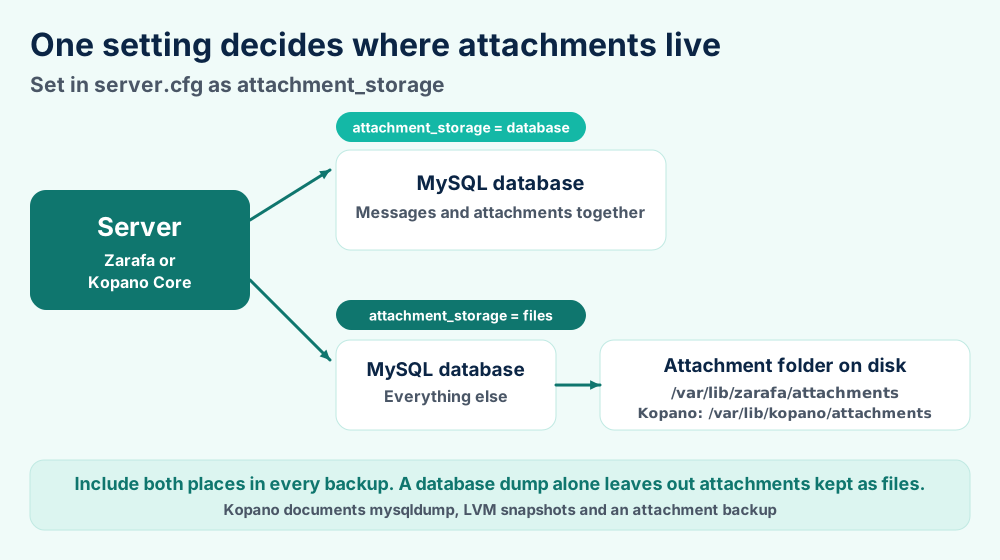
The manual says attachments could leave the database from version 6.0. It adds that version 7.0.5 and later use the filesystem by default. A newer install holds attachments as files. An older one can hold them in MySQL.
Open server.cfg and read the line. If it says files you must copy the attachment folder too. If it says database one dump holds everything.
| Item | Zarafa name | Kopano name |
|---|---|---|
| Config folder | /etc/zarafa | /etc/kopano |
| Attachment folder | /var/lib/zarafa/attachments | /var/lib/kopano/attachments |
| Service user and group | zarafa | kopano |
| Server socket | /var/run/zarafad/server.sock | /var/run/kopano/server.sock |
| LDAP schema prefix | zarafa | kopano |
These names come from the migration manual. They are the quickest way to tell which product you hold. They help most when nobody kept records.
The search index is a side product. It speeds up lookups and nothing more. You can rebuild it from the mail.
The migration manual says ZCP 7.2 index files are compatible with Kopano. ZCP 7.1 index files are not. Plan a rebuild when you start from 7.1.
The administrator manual lists three routes. You can dump SQL with mysqldump or take an LVM snapshot. You also make a backup of the attachments.
The kopano-backup program makes brick level copies of users and stores. That is a third layer on top of the first two. It allows a partial restore later.
Test the restore before you trust any of them. A backup you never opened is a guess. Do it on a spare host and not on the live server.
The migration manual says backups are not compatible between Zarafa and Kopano. It tells you to take a MySQL backup before any move.
No. Wikipedia lists ZCP 7.2.5 from January 2017 as the last release. The vendor says its Groupware line has reached end of life.
Treat a live server of this kind as a problem with a deadline. No maintained release stands behind it. The world around it has moved on.
| Sign | What the sources say |
|---|---|
| Last Zarafa release | ZCP 7.2.5 on 7 January 2017. |
| Last Kopano Core release | 8.7.25 on 23 February 2022. |
| Debian | Last Kopano package update in Q1 2020. |
| openSUSE | Removed its Kopano package in Q1 2021. |
| Kopano Groupware | The Kopano site says it reached end of life. |
| Outlook plugin | Support ended after Q1 2016. |
Old releases carried real flaws. A CERT.hr advisory described a bug in senddocument.php in WebApp and WebAccess. Remote attackers could upload many files and fill the /tmp folder.
Fedora fixed that flaw in its ZCP 7.1.12 packages dated 9 April 2015. One old bug is not the point. The point is that fixes stop when releases stop.
Cut it off from the internet. Let only the staff who need it reach it. Take a backup of MySQL and the attachment folder. Plan the exit.
Public WebApp is the risk. A browser login exposed to the web invites attacks on code whose releases have stopped.
Planning the exit takes less time than most admins expect. Section 10 lists routes that use standard protocols. You need no special tools.
Zarafa copied the Exchange experience but not its engine. It uses MySQL and AGPL code. Exchange uses its own database and a proprietary license.
The two products aim at the same job. The engines underneath differ. The gap shows when you try to move between them.
| Point | Zarafa | Microsoft Exchange |
|---|---|---|
| Maker | Zarafa BV from Delft | Microsoft |
| License | Server side AGPL with some proprietary parts | Proprietary commercial software |
| Data store | MySQL with optional attachment files | One .edb file per mailbox database |
| Outlook link | Plugin with MAPI over SOAP and later ActiveSync | MAPI over HTTP, supported from Outlook 2013 SP1 |
| Phone sync | ActiveSync through Z-Push | ActiveSync from Microsoft |
| Browser client | WebApp | Outlook Web Access |
The shared word in that table is ActiveSync. Wikipedia calls Exchange ActiveSync a closed Microsoft standard. Z-Push is a free version of it. ActiveSync phones can therefore sync with a Zarafa server.
Exchange first shipped as version 4.0 in April 1996 according to Wikipedia. Every Zarafa date on this page falls in 2007 or later.
Storage is the practical gap. Microsoft says a mailbox database is stored as an .edb file. The page on EDB files explains that format.
A Zarafa mailbox sits in MySQL tables instead. That difference is why file copies do not cross over.
Note the shared folders and who can open them. Note any mail rules and signatures that users rely on. You will set those up again by hand in the new system.
Do not plan a move by copying files between the two. The databases share no structure. Move mail through a protocol both sides know like IMAP. Or use PST export files that Outlook creates.
Other mail servers have pages here too. The Zimbra mail page covers a Linux rival and MDaemon covers another mail server. This page sticks to the Zarafa story.
Ask what the new system must hold. Mail alone is simple. Calendars, contacts and shared folders add work.
Ask who needs access during the move. Ask how long staff can live without mail. The answers set your timetable and your batch size.
Staff keep the Outlook feel. WebApp looks like Outlook Web Access. Phones keep syncing over ActiveSync.
Admin work is where the products part ways. The tools, the storage and the license all differ. Plan training for the admin team and not for the users.
Use IMAP first, Outlook second and a Kopano upgrade last. All three keep your mail in formats other programs can read.
The best route out is the plainest one. Use IMAP if the gateway is on. Fall back to Outlook if it is not.
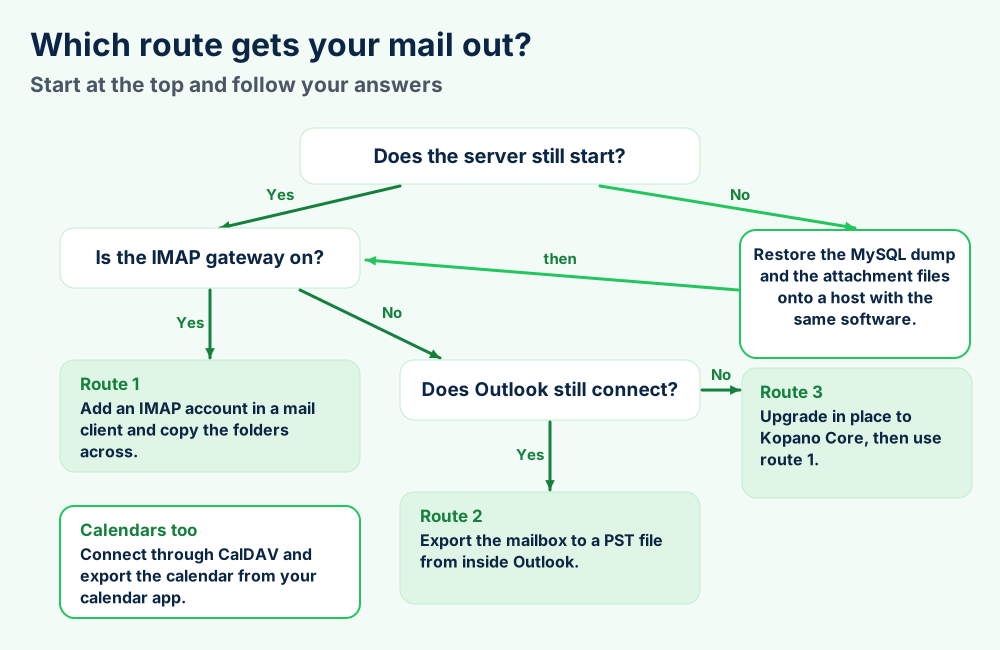
Work in small batches. Start with the smallest mailbox to learn how long a copy takes. Scale up from that number.
Microsoft documents how to export mail, contacts and calendar items to a PST file. The Microsoft support page describes the new Outlook wizard under Settings, Files and Export.
Microsoft adds that calendar and contact items in PST files are not yet available in the new Outlook. Classic Outlook is the safer choice when you need those. The page on the PST format explains what you get at the end.
Kopano calls this a drop in migration. The target is a fork of ZCP. The manual calls the move relatively easy. It also says you proceed at your own risk.
Treat the upgrade as a staging step. When Kopano Core is up, routes 1 and 2 work the same way. Thunderbird stores mail as MBOX mail files. A copy made there lands in that format.
Calendars follow their own path. The gateway side offers CalDAV and calendar apps that speak it can subscribe. Export the result as an ICS file from the calendar app you use.
Wikipedia lists IMAP for mail and CalDAV for calendars. It names no protocol for contacts. Export contacts from Outlook along with the mail.
If you land in Thunderbird note that Mozilla address books use MAB files. Plan a contact import as a separate task.
Users find gaps faster than counts do. Ask a few people to search for a message they know exists. Fix what they report before you retire the server.
A Zarafa server is a set of programs, a MySQL database and an attachment folder. It has no file format of its own.
Zarafa has no file extension. It is a server. Its structure is a set of programs, a database and a folder of attachments.
server_listen_tls = *:237server.cfg in /etc/zarafa or /etc/kopanoattachment_storage = files with attachment_pathThe port numbers come from the Kopano Core 8 manual. Check your own server.cfg before you trust them on an older install. This page found no port list from the Zarafa era.
| Protocol | Role | Detail |
|---|---|---|
| SOAP | Carries MAPI calls to the server | HTTP 1.1 on port 80 or 443 |
| ActiveSync | Syncs phones and newer Outlook | Handled by Z-Push |
| IMAP and POP3 | Standard mail apps | Optional gateway |
| CalDAV | Calendar apps | Optional CalDAV part |
| LDAP | User directory | Port 389 by default or 636 for LDAPS |
The LDAP port numbers come from Wikipedia. A Zarafa setup can also read users from Active Directory.
Facts here come from Wikipedia article on Zarafa and its Kopano counterpart. The administrator manual and migration manual add the technical detail. The Z-Push site covers Z-Push.
Rename dates come from the Debian packaging list and the Collax report. The Kopano Cloud site states the current vendor position.
Where the vendor site and Wikipedia disagree this page states no year. That applies to the end of the Groupware line.
Mail files are the other half of a Zarafa move. The PST files and MBOX files are the common ones. The file format index lists the rest.
Use the IMAP route. Section 10 walks through it.
Restore MySQL and the attachment folder. Section 7 shows both places.
Holding a PST file from an export? The PST guide covers what sits inside it and how to open it.
Did your mail client write an MBOX file instead? The MBOX guide explains that plain text format and its variants.
Found an OST file on an old Outlook PC? OST files describes what that offline copy holds. EDB databases explains the server side that feeds it.
Want to compare with the product Zarafa copied? The Exchange Server page tells the Exchange story from its first release.
Need to learn the mail program at the other end? Microsoft Outlook and SeaMonkey have pages of their own.
Stuck on a Windows or Mac error during the move? Our Windows guides start from the message on screen. Our macOS fixes do the same on a Mac. If neither fits, send us the error or browse the FileFix categories from the home page. You can also contact the team.